

Deep Dive into Product Development
Bagging For Business #10

In this issue, I want to walk you through the entire design process of one of my current bag concepts.
We‘ll dive deep into asking the right questions, solving problems, technical development, and—most importantly—decising-making. That includes balancing intuition and straightforward logic.
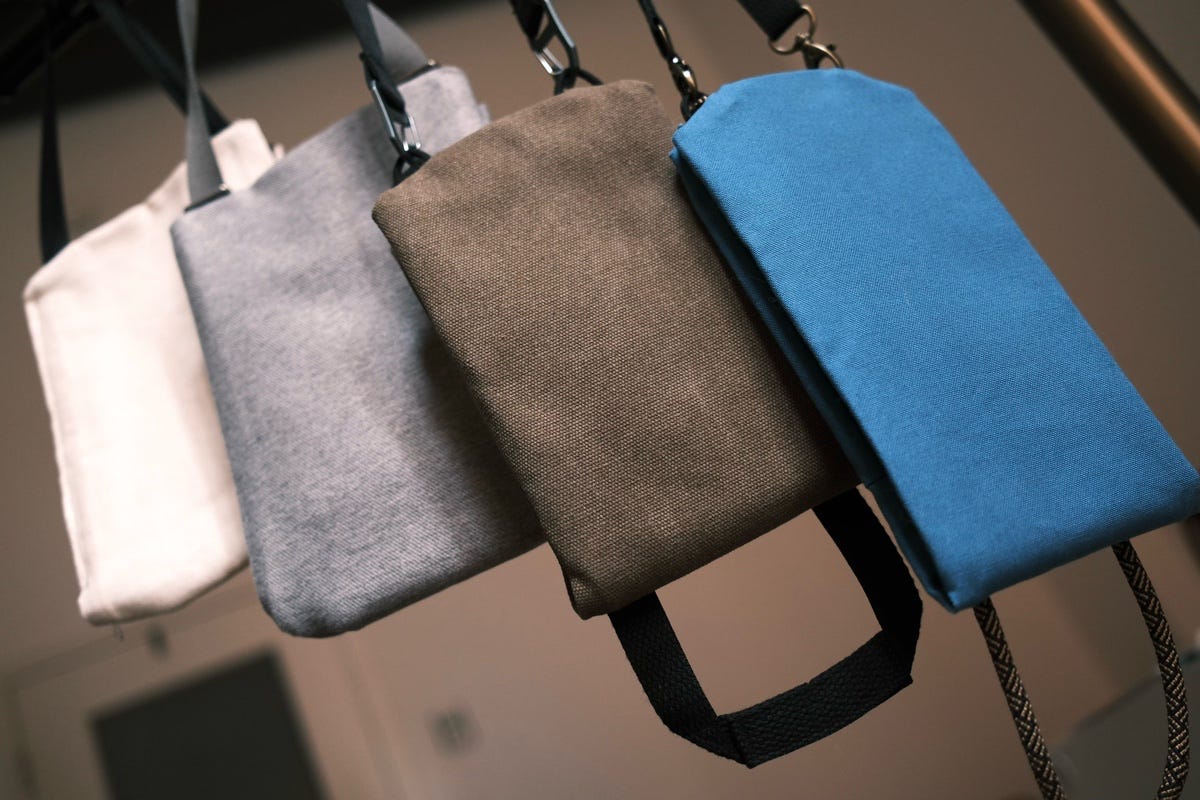
Inspiration for this sacoche bag came from two directions:
There‘s still no elegant way (speaking of dudes like me) to wear your daily essentials low-key.
My most essential item is my phone—it‘s overtaken my wallet and keys by now. I don‘t like carrying this big device in my pants pocket; I still do sometimes out of convenience, but it‘s just too big. In response, my wallet has naturally shrunk over the years, yet my ID, driver’s license, and the bonus card for my trusted burger joint are still essentials. And then there are keys—those bulky buggers. Why are car keys getting bigger and bigger? And what I can‘t live without: music. I don‘t leave the house without at least a small pair of earphones close at hand.
The mass market adapted to the Zeitgeist by selling bags like this:
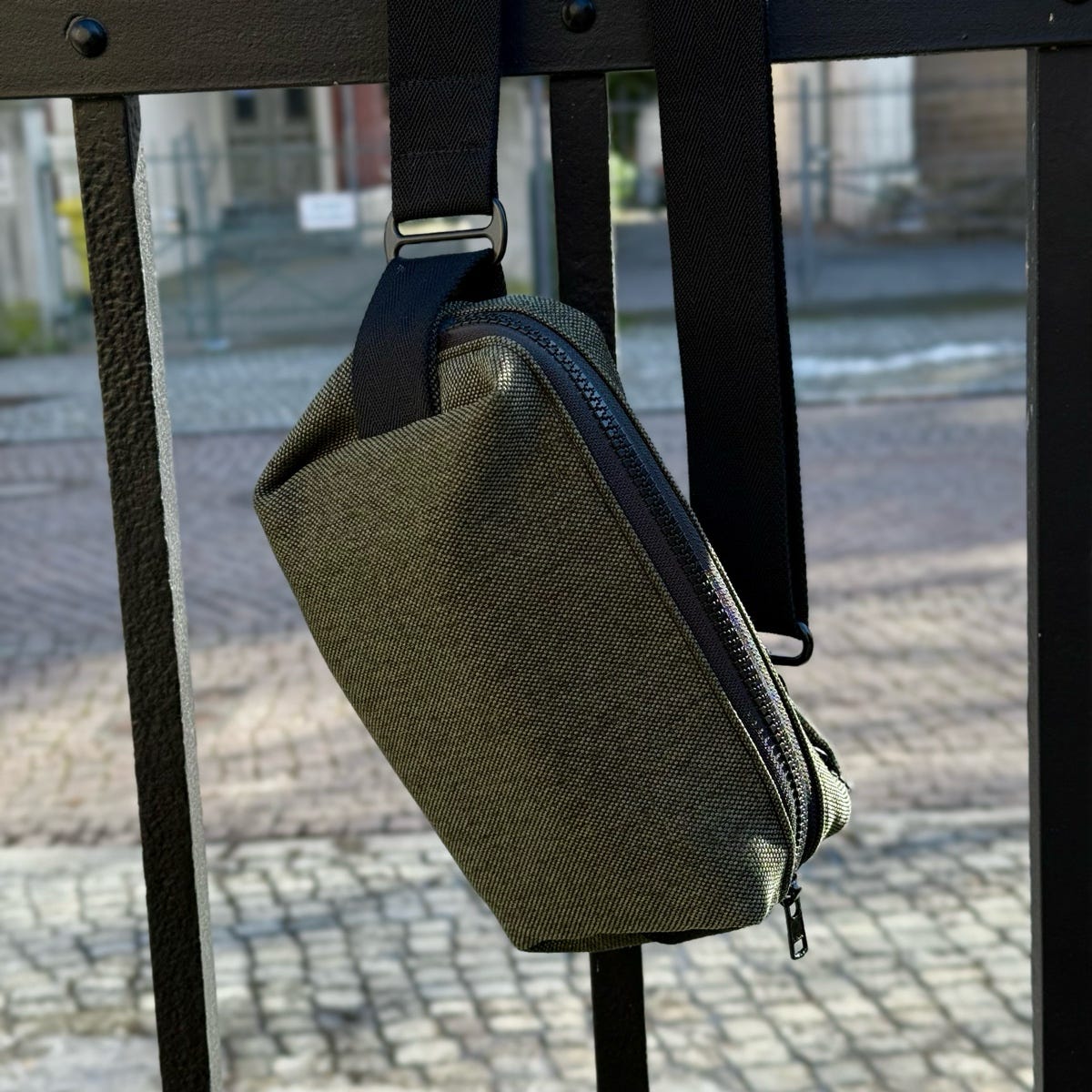
I like them, I wear them a lot myself—but sometimes they just look stupid. And I don’t know, but opening a zipper just beneath your chin looks awkward.
Last winter in London, I found this bag:


I’m still intrigued by the closure. It‘s not particularly practical (especially when the belt runs right through the middle like this), but using it is a delight. It reminds me of the feeling you get snapping shut the case of Apple’s AirPods—just satisfying. Naturally, I wanted to adapt this principle somehow, somewhere.
So, what do I want this bag to be?
Carry a (big) smartphone
A small wallet
Keys
Something like AirPods
The ability to grab my phone as quickly as if it were in my trousers
A slim profile so it can sit under a jacket
No tactical aesthetic—something simple, elegant, and delightful to use
That’s how I’d describe it now. But weeks ago, when I started designing this sacoche, I also wanted room for a small notebook and pen. I even imagined it fitting a larger wallet. I thought: people are different, and the bag should offer flexibility. But inspiration rarely comes as a single idea—you have to start building and see where exploration and testing take you.
Rough Prototyping
I began the project by laying out my essentials on the table and wrapping fabric around them. Usually, I start with quick sketches—just doodles to explore shape and function. But this time, my gut told me to jump into physical prototyping. I needed to play with real objects, tetris them into the most compact, accessible form possible.


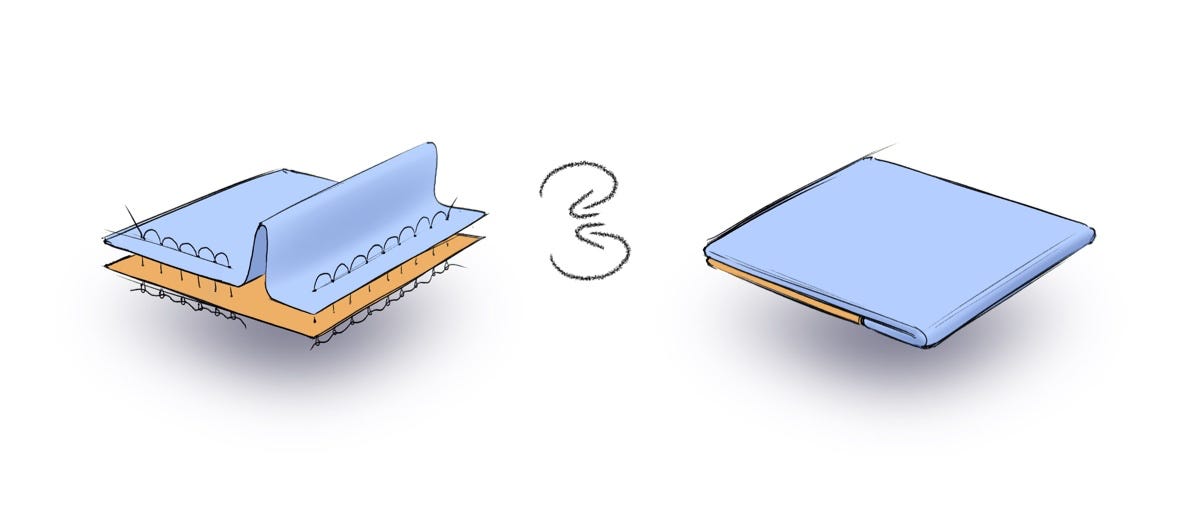
That process led to some happy accidents. For example, I discovered that folding the pockets instead of sewing them onto the lining creates these smooth transitions:
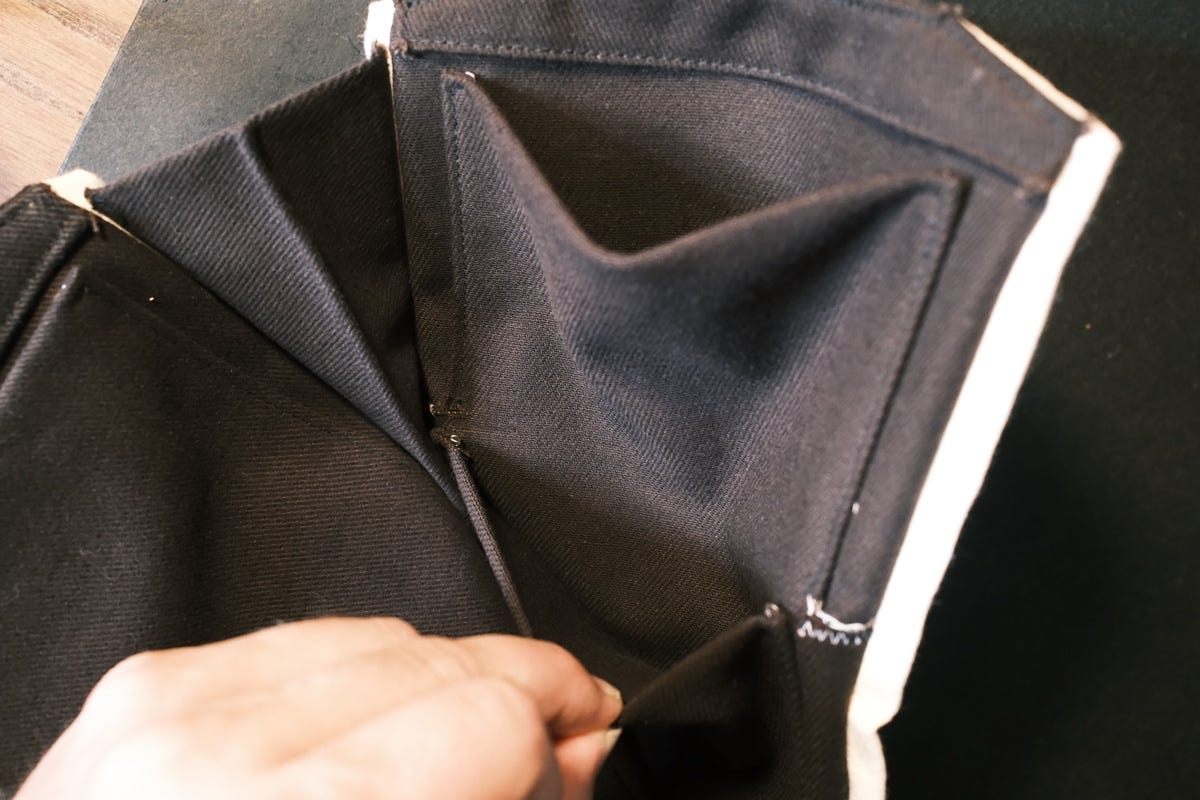
When you put your hand in or pull out some weirdly shaped object (looking at you, keys), there’s no resistance. Nothing awkward. It seems like a small thing, but after using the later prototypes for a while, it just feels smooth. Bonus: this method also helps during production. I only need one fabric pattern, and the z-fold lets me add cushioning from the other side later on.
The first prototypes also defined the central theme: The bag opens like a fan. Your essentials are presented in an orderly, almost ceremonial way.
And how does it close? Gravity. Just like the London bag—it closes itself.
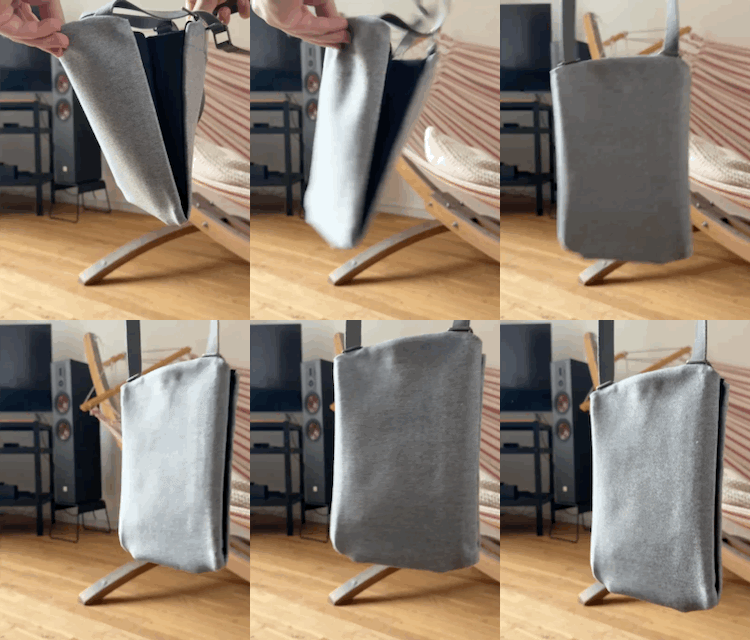
These are the best moments in design, when inspiration falls into place and just feels right. Even if you know that there are hurdles ahead and it’ll be tricky to solve certain details, it screams: You‘ve got something here!
One of the tricky bits: The fan needed to both look good and work cleanly—not like a floppy foreskin dancing around. I also wanted to hide as many seams as possible, so my first attempt—just sewing onto the edges—didn’t work.
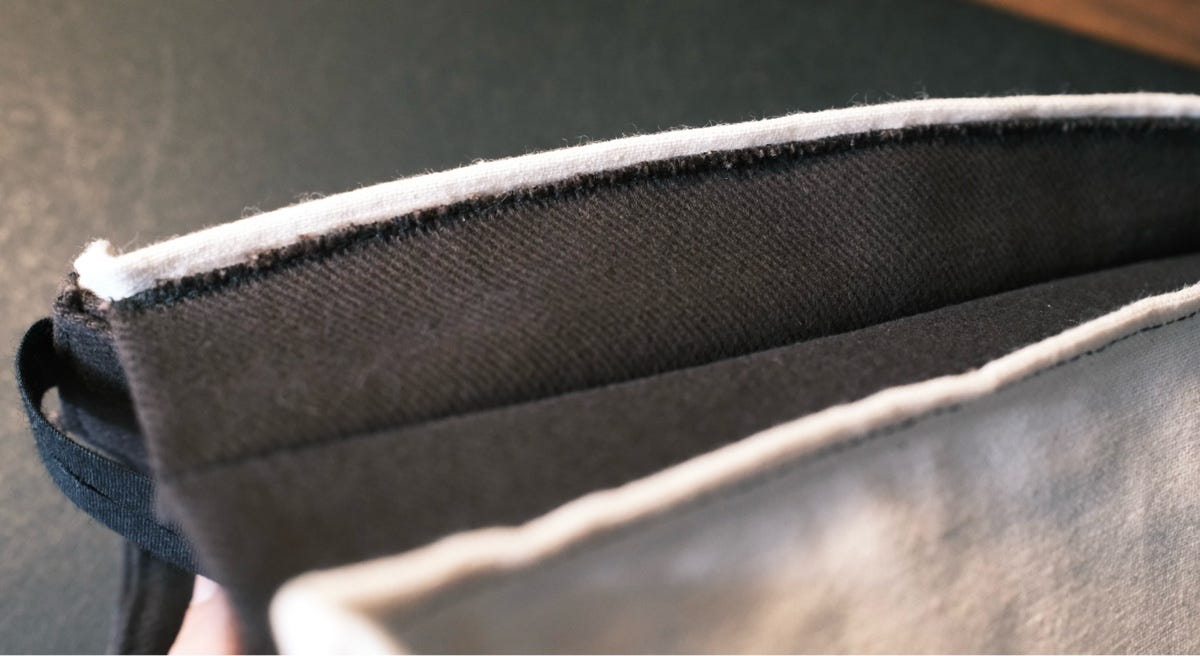
I had to include the fan folds in the main seam and connect the sides after inverting the whole bag. Too nerdy? I could go on about how I stabilized the fan to fold in the right direction, but I guess you‘d fall asleep ;)
Insert: Here are some shots of the lastest version focussing on the fan, judge for yourself:


With the second prototype done, I felt confident enough to try proper materials.
The other day I found this black Italian wool with beautiful pattern work in the leftovers at Textile in Potsdam. It nails the feel and quality I imagine for my brand. Like most of my advanced prototypes, the outer material is upholstery fabric—robust, cozy, tactile. These won’t be the final materials, but they definitely represent the right vibe for this particular piece.
This is the third iteration:


My real world testing was quite a desaster.
The idea to use the same belt for closure and carry doesn‘t work. Not because of access or security, but because opening it shortens the belt, which makes the whole bag ride up. Reaching for your phone feels like your mom might ground you for your posture.
Also, the size and shape were off—it just looked too big. And a little… boring. My jack-of-all-trades approach and my self-proclaimed technical ingenuity messed with the proportions. Honestly, I felt stupid wearing it. So under the vest it went—not for subtlety and style, but out of shame.
So, I left the country and questioned my reason for existence:


Sometimes you need to let your subconscious do the work. It’s like training: recovery is where the magic happens. I thought a month of downtime would mean I’d forgotten everything I learned in the past 6 months. But the opposite was true—my mind felt clearer, my steps more intentional, creative work flows more naturally.
Three main things needed to change:
Solve the belt issue without loosing the unique closure and fan movement.
Make it way smaller—just fit the essentials I mentioned in the beginning.
Try thicker fabrics to see if padding could be eliminated.
Here’s the fourth version I came up with:


Now there are two belts. One to carry—hooked to the top loops (now no longer metal, for weight and simplicity). The second belt runs through the loops and down the back, forming a hanging handle.
That way, you open the bag like before—but to close it, you pull down the handle, and the magnets do the rest.
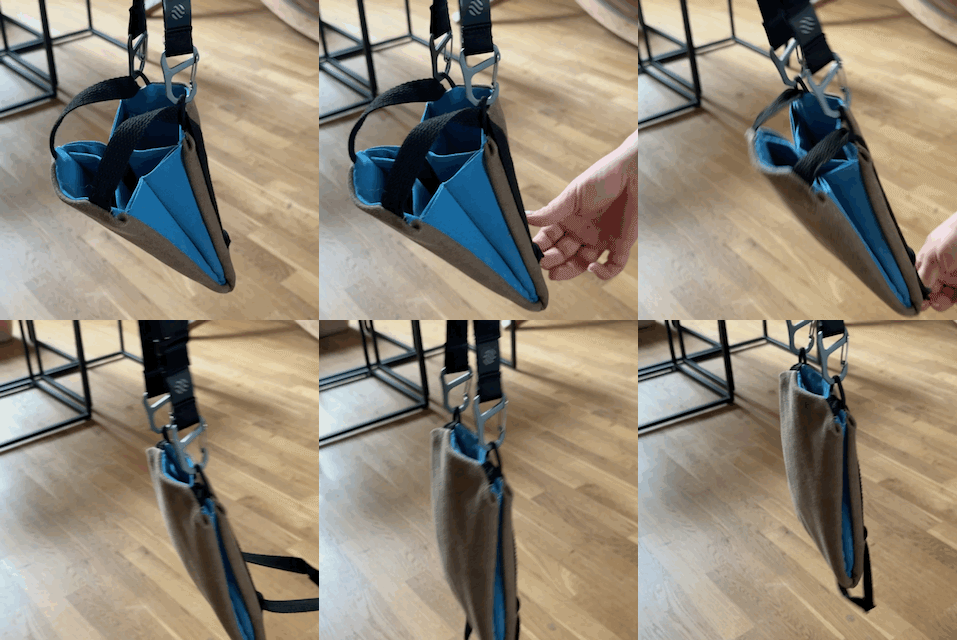
At first, I thought: is this too complex for such a small bag? Turns out, it’s actually more convenient—and faster—than a zipper on a sling.
You might think: okay, but what about theft, or rain, or whatever. Fair. But the user experience is really satisfying and unique, I’ll make it work and I’ll test it thoroughly—in real life, with as much feedback I can get.
So here’s your moment, dear reader. Yes, you. Open Substack and tell me what you think, or write me a dm.
But… materials.
They looked wrong, and they were way too stiff. Folding them into these tricky little corners nearly made my fingers bleed. And the handle appears to have been excreted rather than created.


Additionally the exterior is still off, it‘s still boring and missing details. Also, the layout’s still off. A big phone sits too close to the top opening, so the magnets are basically doing…

And the magnets I got from the Baumarkt (German for hardware store) are not up to the task.
So: back to thinner materials for better precision, plus strategically placed padding (because: keys and phones). The layout needs some minor tweeks and I‘ll test wether a rope is a better handle. I think they‘ll fit the top of the bag better then the wide bands.
My current prototype:
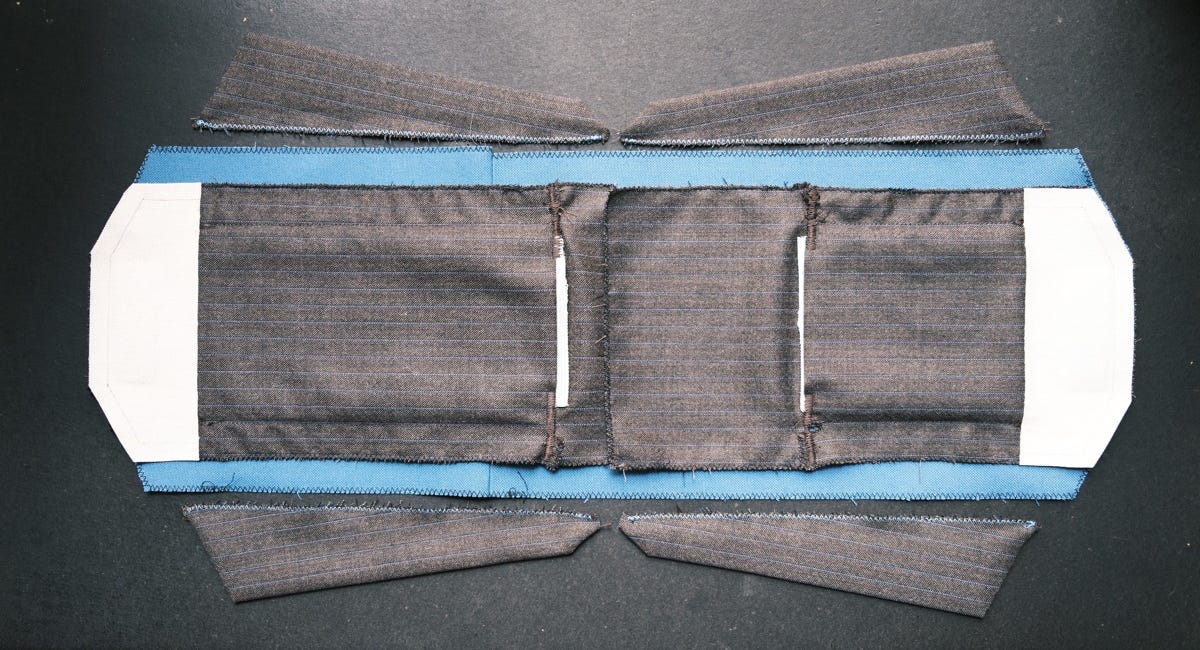
Ignore the current colors—though I gotta say, that interior lining with suit wool is looking kind of cool.


Some pics from production:
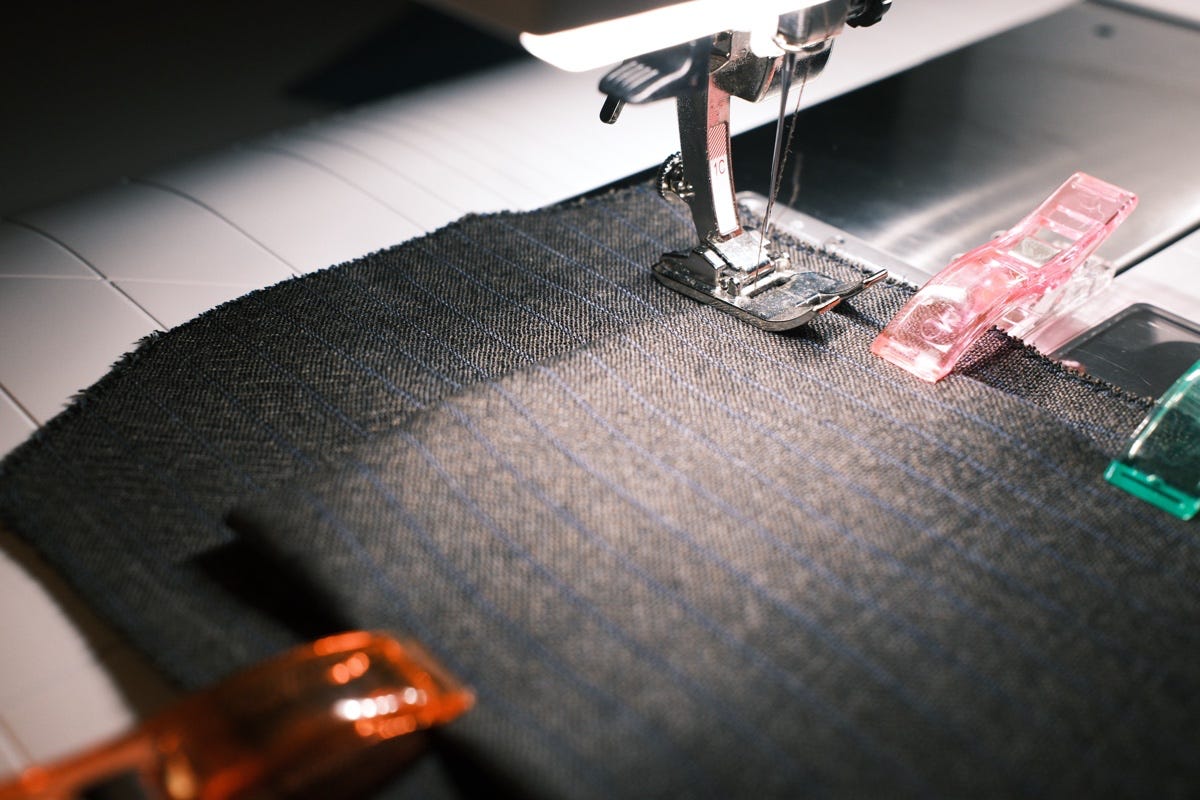
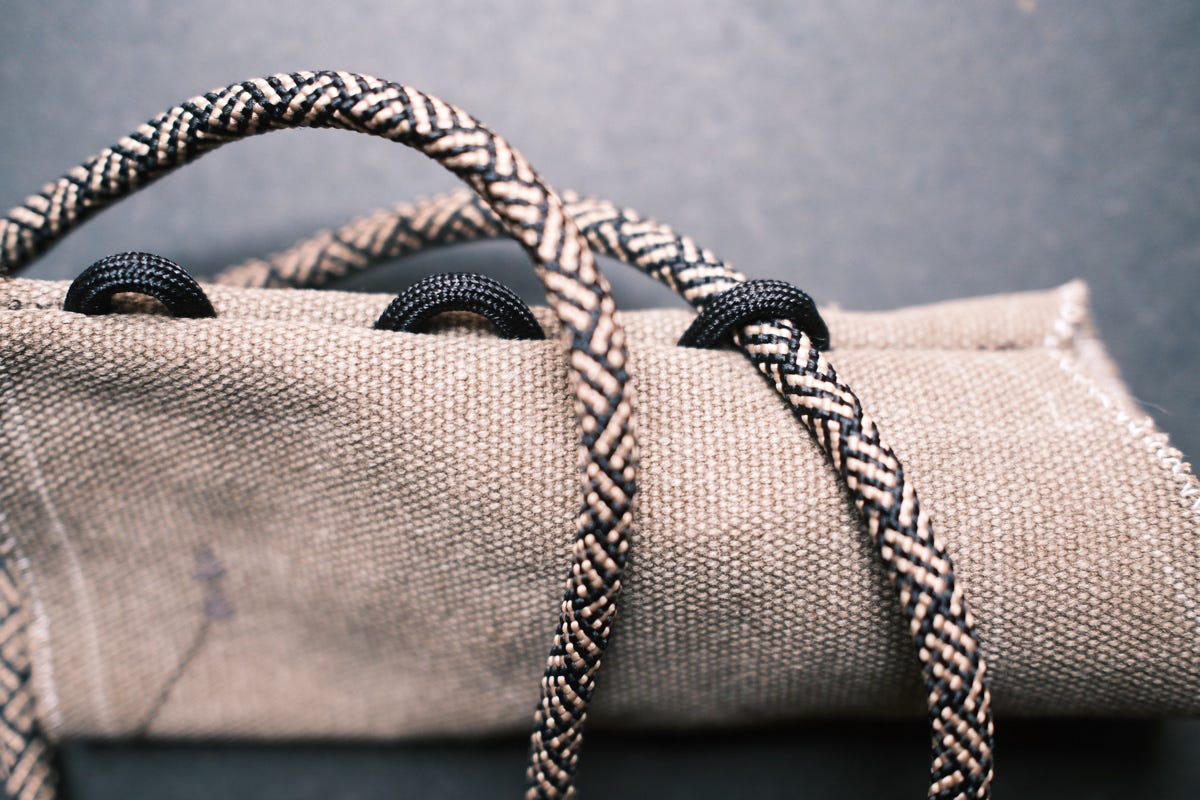
I‘m particularly proud of the transition from the exterior fabric to the interior lining:
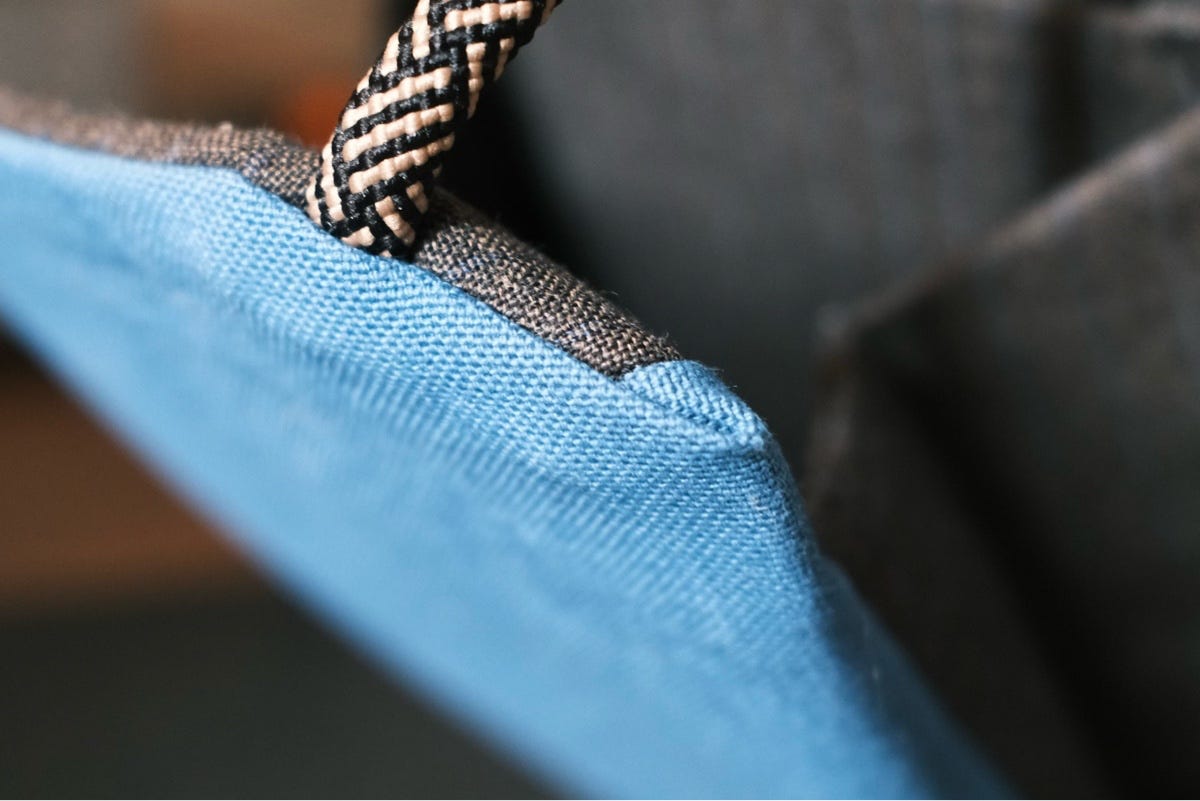
To achieve that I sewed it like this:
That‘s the current status.
I‘m still not happy with the shape. This tends to happen when you skip proper silhouette sketching in the beginning of the design process—you end up paying for it later.
Still, there’s something about this bag that draws me in.
Maybe the right material combination will make the simple shape shine. A more visible pattern that offers the level of detail needed.
I imagine this bag working well under an unbuttoned jacket or shacket. You’d only see the cross belt and the rope handle hanging down. Which means those visible elements really have to be on point—quality and design-wise.
Especially these days, when men around my generation like to avoid overt decoration, small, thoughtful details like this could add just the right amount of personality to an otherwise calm outfit.
And since I’m aiming to use no plastics, with no zippers or metal parts, you could take off the cross belt and toss the whole bag in the washing machine.
What about women or non-gender-specific folks? Would you wear something like this?

Sehr interessant. Krasse Reise! Die Kordel mit Magneten hat wirklich n haptischen Reiz. Ich würde gern den Prototypen testen und zahl auch gern dafür :-)
Farblich auch gut, schön zurückhaltend (grau, innen Türkis). Die Kordelfarbe passt noch nicht aber das sind ja triviale Kosmetika. Ich bin sehr gespannt!
Hey Mathias,
Mir gefällt an der Tasche total gut, dass man sie mit einer Hand schließen/ bedienen kann (super, wenn man eine Leine mit Hund in der anderen hält) und, dass es ein lautloser Verschluss ist (Stichwort Jagd) und dann dachte ich, wie gut du offensichtlich darin bist einen Bedarf zu denken, bei dem ich erst durch dich drauf gekommen bin, was viel praktischer wäre als meine bisherigen Lösungen. Und das obwohl du diese Bedarfe nicht vordergründig im Sinn hattest. Wie viel mehr universell kann es noch werden? Ich bin gespannt. Zum Design: ich mag eigentlich das Querformat der klassischen gürteltaschen, verstehe aber, dass es dadurch am Körper sperriger werden würde. Vielleicht würde die Länge der Kordel zum Schließen dadurch aber reduziert. Mich würde auch interessieren wie die Tasche befüllt aussieht. Und vielleicht kann ja auch die Seite mit der Kordel die Vorderseite werden und da irgendwie Funktionalität und Design vereinen und interessant machen.